The best Australian cyclists in history

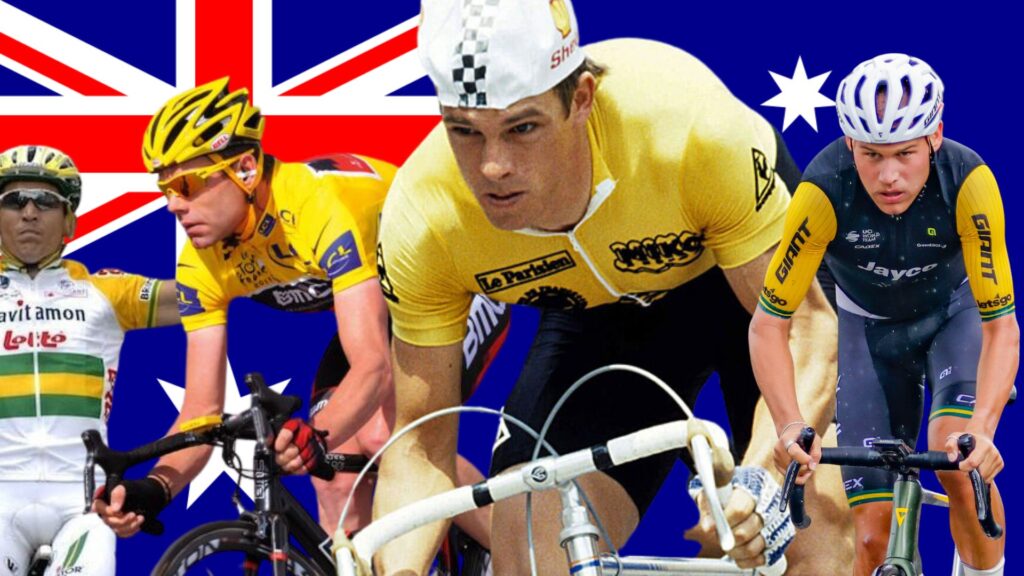
Australian first appearances in the Tour de France date back to 1914, when Don Kirkham and Iddo Munro competed in what was by then the most prestigious cycling race. The brave Opperman, the dedicated Bainbridge, and the successful Mockridge, who would return from the 1952 Helsinki Olympics with two gold medals, were some of the names that paved the way for Phil Anderson to finally put Australia in the yellow jersey for the first time in 1981.
A quarter of the way through the 21st century, the Australian flag is one of the most common symbols in professional cycling. We’ve become accustomed to seeing it represented by a World Tour team that rides it all over the world. The globalization of cycling has clearly benefited Australians, and it’s rare to find an elite team without an Aussie among its riders.
It happened at Pla d’Adet, the finish of the fifth stage, where the Peugeot rider shared the spotlight with two of the greats: Lucien Van Impe and Bernard Hinault. That June 30th marked a milestone in cycling history, as it saw the first non-European rider wear the Tour de France leader’s jersey. Since then, Australia has only continued to rise in the international cycling scene. In fact, the Melbourne-born rider himself (though Londoner by birth) wore the yellow jersey for nine days in 1982, in addition to winning a stage. He was a tenacious cyclist who was soon recognized for his true worth. He won, among other races, the Dauphiné, the Tour de Suisse, and the Amstel Gold Race, which earned him a place among the most well-known riders in the peloton.
Later came others like Neil Stephens, Patrick Jonker, and the more successful Robbie McEwen and Stuart O’Grady. The nineties continued the path opened by ‘Skippy’ and raised the bar even higher. One became a dominant sprinter, one who even silenced Lance Armstrong with a raised fist during his years of dominance. The other would conquer the first Monument for Australians, the 2007 Paris-Roubaix. Only Matthew Hayman, almost a decade later, would manage to lift the cobblestones to the accompaniment of the Australian national anthem.
In the 2011 Milan-San Remo, the surprising Goss triumphed, followed by the tenacious Simon Gerrans in 2012, who would later etch his name in Liège-Bastogne-Liège. The race was already home to sprinters of the caliber of Baden Cooke and Graeme Brown, as well as prologue specialists like Bradley McGee. However, the greatest Australian cyclist of all time was also riding there, and he deserves special mention.
Cadel Evans emerged from mountain biking, nearly won the Giro d’Italia almost by accident, and was also the first Australian to take home the rainbow jersey of world champion. He won the Tour de France in 2011, confirming that Australia was here to stay. The cyclist from Katherine became a role model for future generations. Furthermore, he created the Ocean Race that bears his name, expanding the cycling calendar in Australia by linking it to the Tour Down Under, a historic sporting event that has kicked off each season for thirty years. Reaching the podium in all three Grand Tours, like him, inspired new riders to emulate such a goal.
Jack Haig and Ben O’Connor both achieved podium finishes at the Vuelta a España. However, the second-best Grand Tour achievement was Jay Hindley’s victory in the 2022 Giro d’Italia. He had the chance to win the 2020 edition, the one marked by the pandemic and a turning point in his career. Meanwhile, Rohan Dennis controlled the peloton on the Stelvio Pass, paving the way for Tao Geoghegan Hart, Hindley’s teammate at Team Sky, to take the victory.
Dennis was world time trial champion, although a large number of victories in the competition belong to another Australian, Michael Rogers. They won in three-week stage races, in classics, and in sprints. It was Australia’s golden age in cycling, culminating in the creation of a top team under the Green Edge project. Richie Porte became one of the best cyclists in the world in week-long races.
Michael ‘Bling’ Matthews has been another of Australia’s most prestigious cyclists. In addition to his great speed and intelligence, he has dominated every single discipline of the UCI World Tour. Caleb Ewan and Kaden Groves have dominated the sprints, just as Simon Clarke and others have climbed the ranks in the mountains.
However, it will be Jay Vine who, after mastering the innovative world of virtual cycling, takes a leap forward to become one of the top Australian riders alongside Luke Plapp.
There are still steps to take, such as breaking into the dominant ranks, whether in the Grand Tours, or conquering uncharted territory like Lombardy, Flanders, or the Vuelta a España itself. Everything else has fallen into place in this process of conquest that Australian cycling has accelerated in recent years. 
COmments
0 comments
Deja una respuesta

¿Quieres contactar?